Build a community that can stand the test of time.
Buying land together starts with a shared vision. Making it work takes clear decisions about the land, the money, the work, and what each person is agreeing to.
Legacy Communities is a guided workspace for groups building a life on shared land. Explore the questions that matter, compare expectations with care, record decisions, and keep a reliable history as the community grows.
Product preview. Subscription access is coming later.
From first conversations to written decisions. See the actual workspace below.
BEFORE THE FIRST BIG DISAGREEMENT
The land may be shared. The assumptions usually aren't.
One person may believe a contribution buys a share of the property. Another may see it as help between friends. Someone assumes everyone will work every weekend. Someone else expects to be free to come and go.
These differences are easier to discuss before money is spent, houses are built, or responsibilities become permanent.
Who has the right to live on the land? Who approves a large expense? What counts as a contribution? What happens when a member wants to leave? What happens if the people who started the project no longer agree?
A good community doesn't need identical opinions. It needs a way to surface the differences, make decisions fairly, and remember what was decided.
CHOOSE YOUR STARTING POINT
Start with the community you're actually building.
You shouldn't have to learn every governance tool before you can begin. Choose a starting point and the workspace brings the most relevant questions forward. You can explore the other tools whenever you need them.
Friends and Shared Land
For a small group buying, developing, or living on land together.
Start with the essentials: who owns or controls the property, who can participate, how expenses are shared, how everyday decisions are made, which responsibilities belong to whom, and what happens when plans change.
Fewer decisions at once. Clear records from the beginning.
Village and Communes
For larger groups coordinating several households, shared spaces, and long-term stewardship.
Work through the foundational agreements, then take a closer look at membership, delegated decisions, shared assets, budgets, work coverage, conflict processes, and continuity when people join or leave.
More people and moving parts. A clearer way to organize them.
Both starting points use the same underlying workspace. Your community can change its approach and explore additional tools later.
DECISIONS BEFORE TOOLS
Make the important decisions in an order that makes sense.
01. Start with what's true today.
Name the project and describe its purpose, land situation, and the people involved. A property that one person already owns creates different questions from land a group hasn't purchased yet.
02. Hear from each person.
Use guided questions to bring expectations into the open. Members can record private answers and choose what they share. Short explanations show why each question matters, with examples to help people begin.
03. Turn differences into decisions.
Discuss options, write the exact proposal, set the applicable decision process, and keep a record of votes and outcomes. An idea stays an idea until the required decision is actually made.
04. Keep money and work understandable.
Record reported contributions, expenses, shared budgets, duties, and supporting notes. Distinguish what someone reported from what the group has reviewed or approved.
05. Build a record your group can return to.
Bring the relevant approved decisions into a versioned community charter, with a history of changes as the group develops. Use that record for conversations with the local professionals responsible for formal legal or financial documents.
A LOOK INSIDE THE APP
A shared place for the conversations that shape your land.
Know what to discuss next.
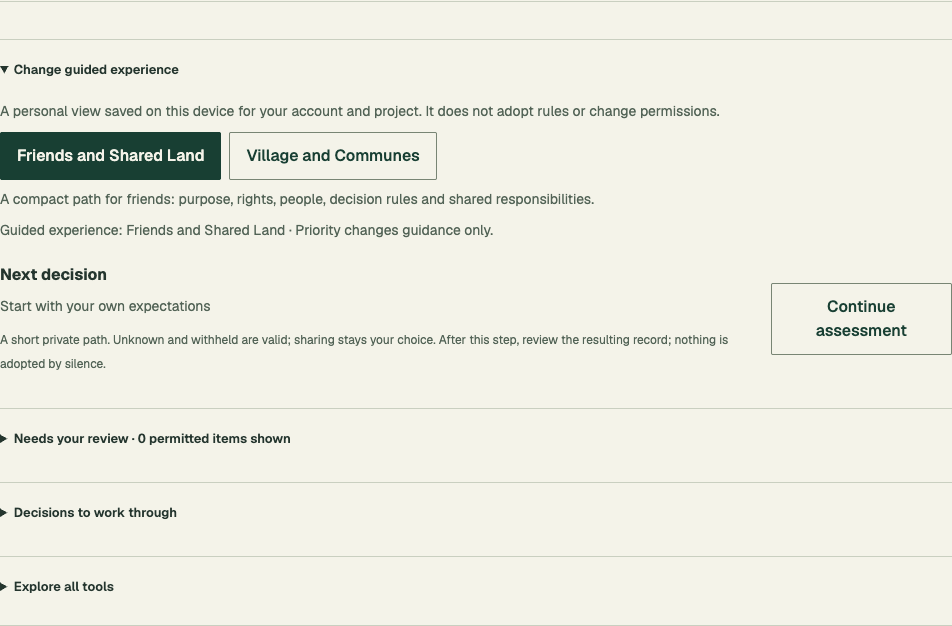
Choose Friends and Shared Land or Village and Communes. The guided journey brings the next relevant decisions forward while keeping the full toolset available.
Every question comes with context.
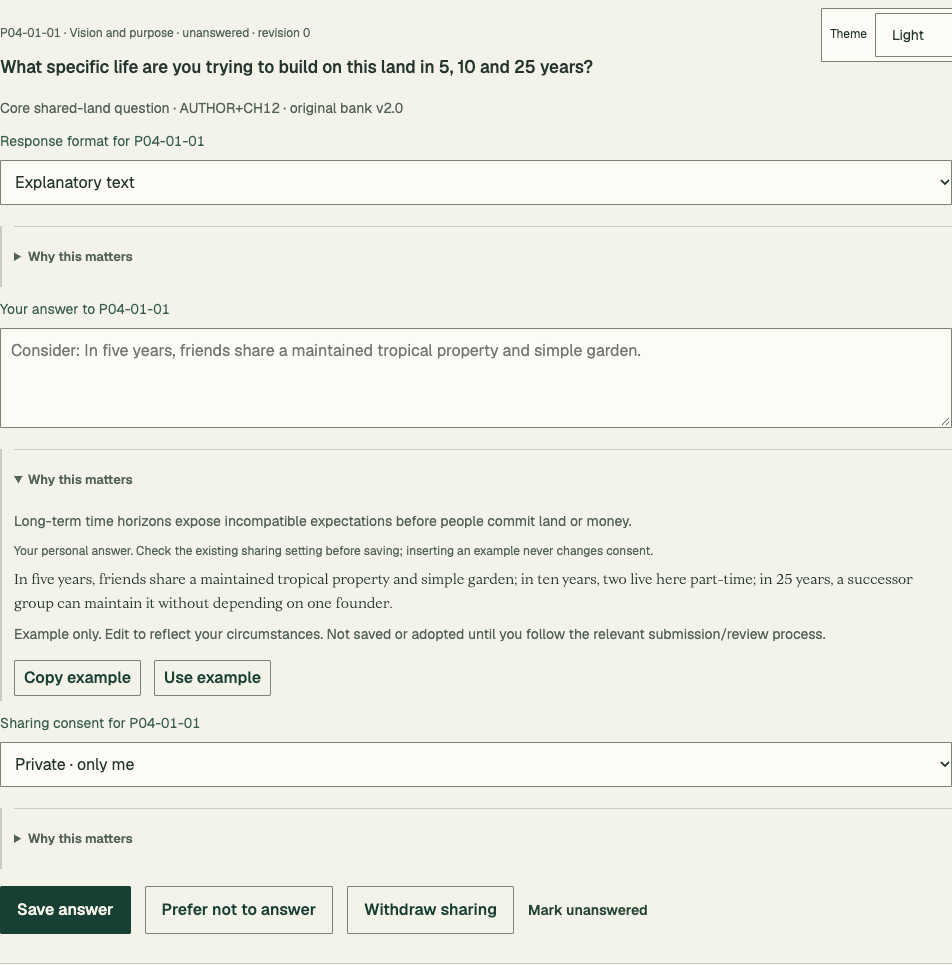
Read why a question matters, copy an example, or use an example as an editable draft. Nothing is submitted or approved just because an example was inserted.
Know what the group actually decided.
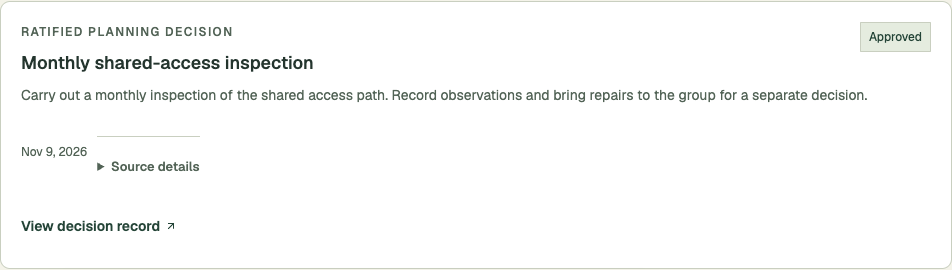
Capture a proposal's wording, eligible votes, decision status, and effective dates, rather than relying on someone's memory of the conversation.
Keep your community record together.
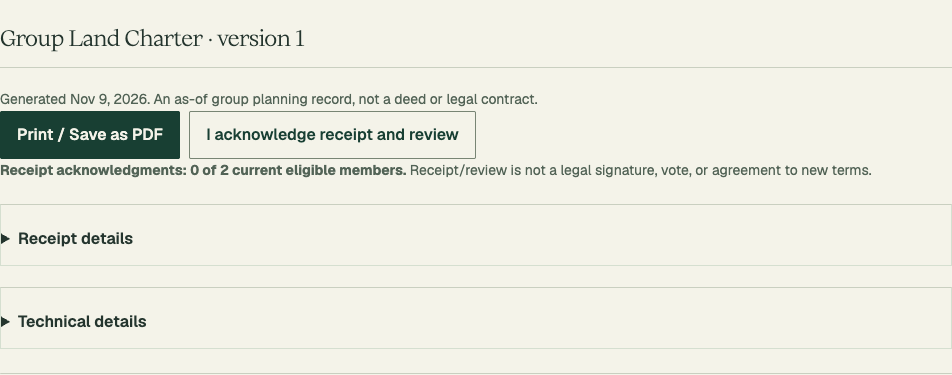
Follow contributions, responsibilities, and approved agreements into a reviewable charter history. Drafts and reported payments are not presented as verified ownership or bank transactions.
MADE FOR REAL GROUP RESPONSIBILITIES
Keep the important parts of community life in view.
Shared purpose and land context
Make it clear what people are trying to build, what land is involved, and which ownership or access questions still need outside verification.
Private expectations and guided discussion
Give each person room to answer honestly, with control over what is shared, before the group tries to force agreement.
Proposals, voting, and agreement history
Track proposed rules, exact decisions, who was eligible to decide, and how agreements change over time.
Contribution and expense records
Document reported money, materials, labor, and other contributions alongside review status and supporting evidence. The app records information; it does not move funds.
Meetings, work, and shared resources
Keep track of meeting outcomes, responsibilities, shared assets, budgets, and tasks that need an owner or backup.
A living charter record
Create dated snapshots of the group's relevant approved decisions and keep the earlier versions available for reference.
Start with the essentials. Bring in more detail when the community actually needs it.
A LONGER VIEW
Clear agreements make more room for the life you're building.
People come together around land because they want something worth sharing: a place to grow food, raise families, pool effort, or care for a landscape over many years.
The hard part is keeping that vision intact through ordinary changes. A missed payment. An uneven workload. A new household. A different idea of how the land should be used.
Putting the rules and responsibilities in writing won't prevent every disagreement. It gives people something better than an argument about what they thought everyone meant.
BEFORE YOU BEGIN
A few things worth knowing.
Do we need to own land already?
No. You can begin by organizing your goals and questions before purchasing land. If land is already owned by one person or an entity, the workspace helps the group clarify that starting position rather than assuming everyone has equal legal rights.
Will everyone see my private answers?
No. Individual assessments have privacy and sharing controls. Group discussion uses information people have explicitly chosen to share under the applicable access rules.
Does Legacy Communities transfer money or create legal ownership?
No. It records reported contributions, approvals, decisions, and internal arrangements. It does not move funds, verify bank balances, transfer title, or replace locally qualified legal and accounting professionals.
What if we need more features later?
You can explore the other tools as your group's needs change. Choosing a simpler starting profile is a way to focus the journey, not a way to erase records or bypass safeguards.
Can we change an agreement after adopting it?
The workspace supports a documented amendment process with a history of the earlier decision. An existing agreement is not silently rewritten just because someone edits a description.
Is the subscription open?
Not yet. This website is a preview of the product being prepared for broader access. Subscription details and a secure checkout link will appear here when enrollment opens.
LEGACY COMMUNITIES
Start with a shared vision. Keep a shared record.
A serious land project deserves more than scattered messages, half-remembered conversations, and assumptions about who agreed to what.
Legacy Communities is being prepared as a subscription workspace for groups that want to make those decisions deliberately and keep their records together.